A humanoid can be touched while executing an expressive motion, requiring behavior updates without disrupting continuous execution. This is challenging because tactile state, touch-type estimation, and vision-based spatial context operate at different temporal scales. We hypothesize that separating these streams according to their temporal roles enables asynchronous updates while preserving fixed-rate control. We present a touch-responsive humanoid system with a temporally decoupled runtime architecture and interruptible motion execution. A 200 Hz region-wise tactile state supports immediate interruption or hold requests, while slower touch-type and vision-derived occupancy streams update the pending behavior. An anchor-based executor redirects the motion at the next valid anchor. The analytical command-level timing estimate is approximately 14 ms under the assumed stage delays, excluding anchor waiting time and actuator response. A 20-participant study evaluates four touch classes. Across 60 interaction trials, the intended transition was selected in 55 cases (91.7%), and all selected motions satisfied their predefined continuation, hold, or anchor-based redirection outcomes, with no observed robot–human collisions under tested conditions.
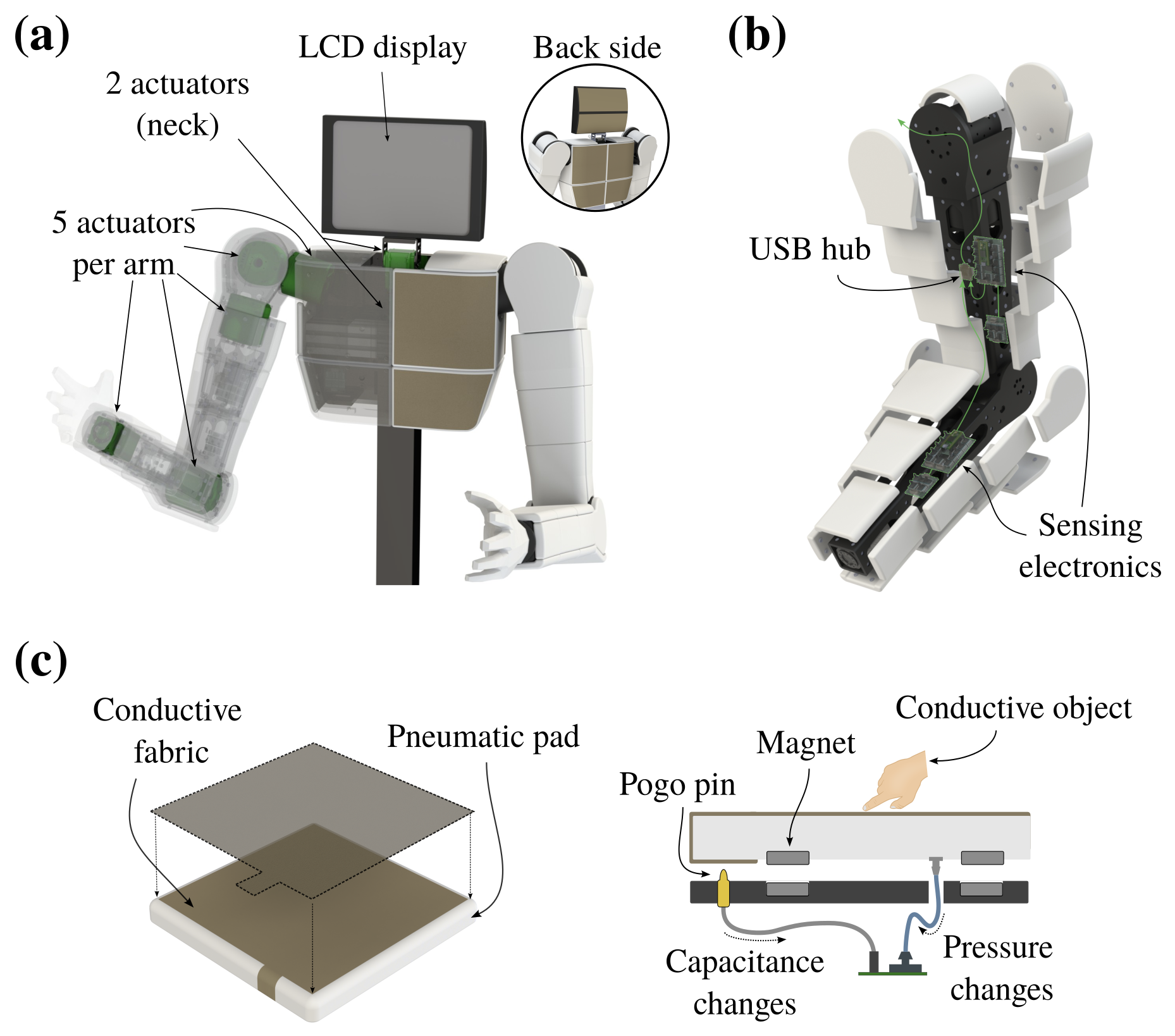
(a) Upper-Body Platform: The 12-DoF humanoid combines a 2-DoF head and two 5-DoF arms. An LCD display presents facial expressions synchronized with upper-body motion.
(b) Link-Level Sensing Electronics: Local Teensy 4.0 microcontrollers condition and aggregate tactile signals near each robot link.
(c) Multimodal Skin Element: Pneumatic pads capture contact pressure, while conductive fabric electrodes detect proximity and light contact through capacitance changes.
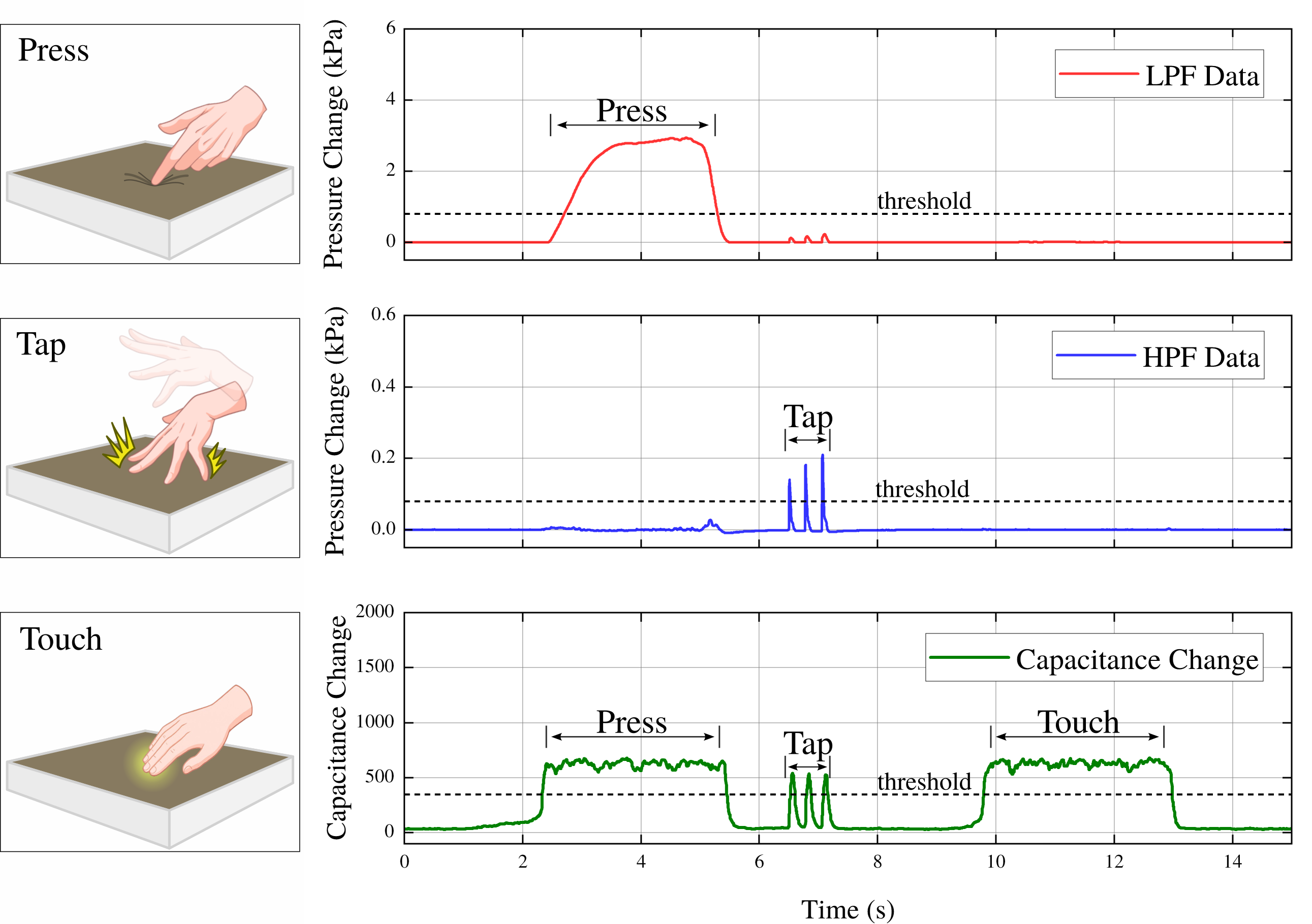
Our humanoid's multimodal skin combines pneumatic pressure and capacitive sensing to provide complementary cues.
Press: Low-pass pressure captures sustained contact.
Tap: High-pass pressure captures impulsive contact.
Touch: Capacitance captures proximity and light contact.
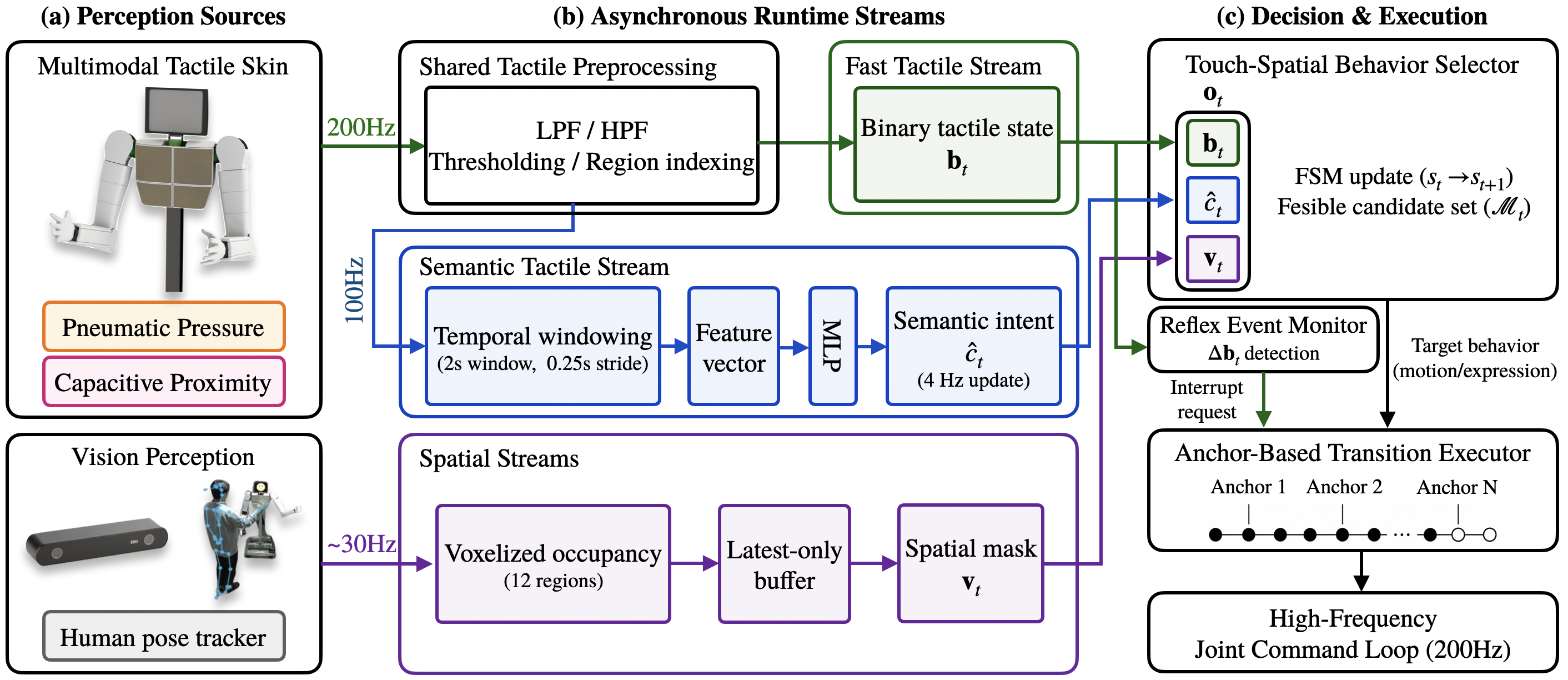
(a) Perception Sources: Our pneumatic and capacitive skin provides pressure, impulse, and proximity cues indexed by body region. In parallel, a stereo camera tracks human pose to estimate occupancy around the robot.
(b) Asynchronous Runtime Streams: Fast tactile monitoring, touch-type estimation, and spatial occupancy update independently at 200 Hz, 4 Hz, and approximately 30 Hz, respectively. Each stream provides its latest observation without blocking the command loop.
(c) Decision & Execution: The selector updates the pending behavior using tactile and spatial context, while direct tactile changes can issue higher-priority hold or interruption requests. The executor maintains 200 Hz commands and redirects motion through a validated transition at the next allowable anchor.
Our system maps human pose observations to a 12-region occupancy vector that informs FSM updates and filters candidate upper-body motions. The videos show how occupancy changes as a person moves around our humanoid.
@misc{jeong2026trhi,
  title = {Temporally Decoupled Touch-Responsive Humanoid
           Interaction with Interruptible Motion Execution},
  author = {Jeong, Taemoon and Ma, Junghyeon and Kim, Chanwoo
            and Min, Junha and Bang, Yunseong and Park, Jeongeun
            and Choi, Sungjoon and Park, Kyungseo},
  year = {2026},
  note = {Manuscript}
}